In 2019, a team at Cincinnati Children's Hospital Medical Center did something that had never been done before. Instead of asking whether kids who watch more screens behave differently, they looked directly at the structure of the developing brain itself.
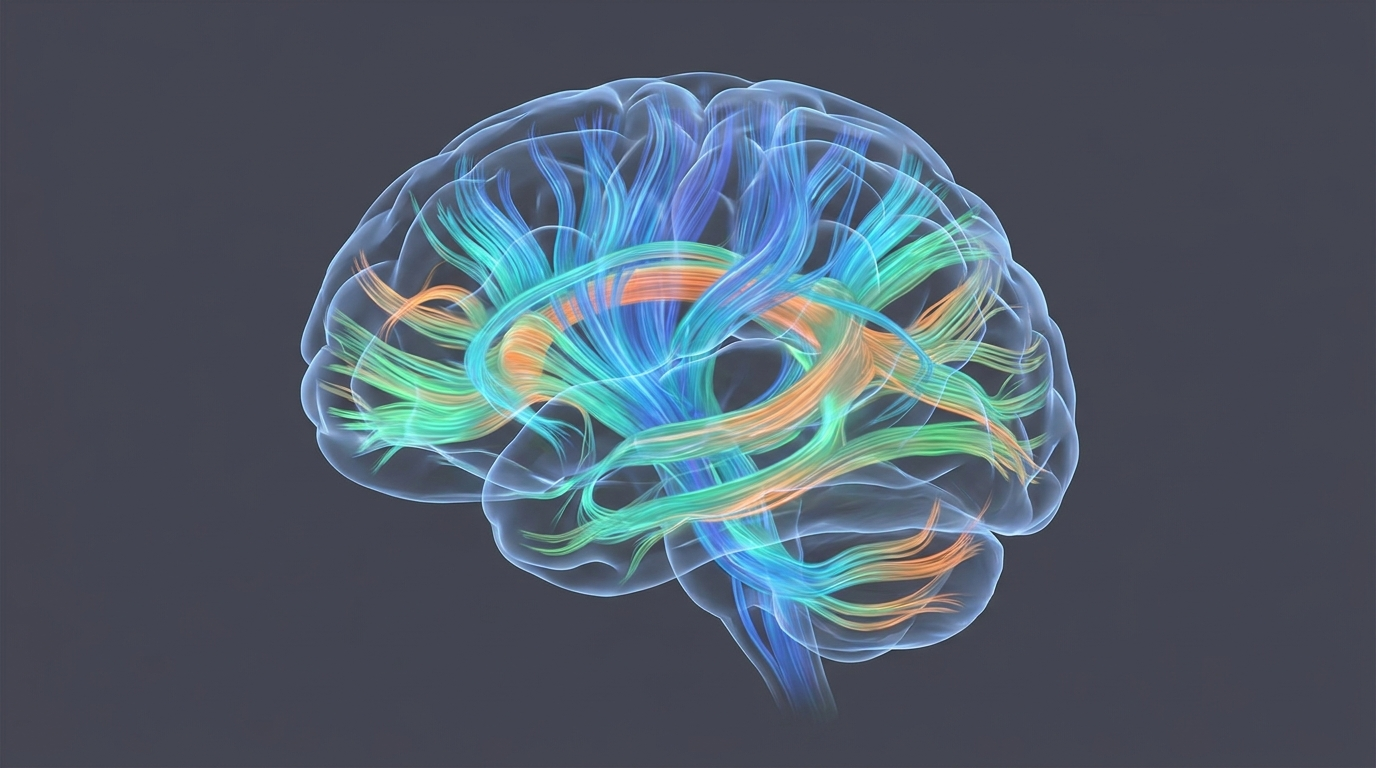
Forty-seven healthy children between the ages of 3 and 5 went through cognitive testing and a type of MRI called diffusion tensor imaging, which maps the brain's white matter. White matter is the wiring of the brain. It's the network of tracts that lets different regions talk to each other, and in the preschool years it is being built at a pace that will never be repeated again in your child's life.
Each child's parents also completed a screening tool called ScreenQ, which measures how a family's screen use compares with the American Academy of Pediatrics guidelines: how early kids get access, how often they use screens, what they watch, and whether a parent watches with them.
What the scans showed
The children with higher screen use scored lower on tests of expressive language, processing speed, and early literacy skills. That part had been seen before in other research. The new part was in the images: higher screen use was also associated with lower structural integrity in the white matter tracts that support language, emergent literacy, and executive function, which is the mental skill set behind focus and self-control.
The kids who spent the most time on screens showed less developed wiring in the exact parts of the brain a child needs for reading, speaking, and paying attention.
These differences held up even after the researchers controlled for the children's age and household income. The findings were published in JAMA Pediatrics, one of the most respected medical journals in the world, in a paper titled "Associations Between Screen-Based Media Use and Brain White Matter Integrity in Preschool-Aged Children."
What it does and doesn't prove
We'll be straight with you, because you deserve better than scare marketing. This was a study of 47 children at a single point in time. It shows an association, not proof that screens caused the differences, and the authors themselves say more research is needed. No honest brand or pediatrician will tell you a tablet "damages" your child's brain, and you should be suspicious of anyone who does.
But here's what is not in dispute. The American Academy of Pediatrics recommends firm limits on screen use in early childhood, citing risks to language development, sleep, executive function, and time spent engaging with parents. The World Health Organization goes further for children under 5, discouraging screen time almost entirely at the youngest ages. And the average American child under 9 is now estimated to spend more than 2 hours a day on screens outside of school and childcare.
One of the study's authors described what's happened to childhood as a vast uncontrolled experiment. Your child is in the experiment either way. The only question is which group they're in.
Why the early years matter so much
The reason researchers focus on ages 3 to 5 is that white matter development in those years lays the foundation everything else gets built on. The tracts that support reading are wired before a child ever reads a word, through talking, being read to, and hands-on exploration of the physical world.
This is also why waiting is the expensive option. An attention span is far easier to protect while it's forming than to rebuild after years of high-speed, algorithm-fed content have set the baseline for what feels "interesting." Ask any parent who has tried to reverse it at age 12.
What actually works (hint: it isn't banning)
Every parent has tried the ban. It produces a fight, a grudge, and a kid staring at the ceiling asking what they're allowed to do now. The research points somewhere more useful: the problem isn't only what screens do, it's what they displace. Talking, playing outside, handling real objects, and discovering things are the activities that build the very tracts the study measured.

So the practical move isn't subtraction, it's substitution. Give the real world a fair fight for your child's attention. Kids don't cling to tablets because tablets are unbeatable. They cling because nothing within arm's reach is more interesting.
That belief is the entire reason our company exists.